

A Dodgers hedge, a few crowded bars, and the opportunity growing around prediction markets.
A Los Angeles hospitality group found a fairly practical reason to use prediction markets.

It runs 25 bars, many near Dodger Stadium. A longer playoff run means more people showing up, watching games, ordering drinks, and generally behaving like people whose baseball team still has a chance.
An early playoff exit means some (alot) of that business disappears.
According to Kalshi, the group put $60,000 into a position that would pay if the Dodgers failed to reach the World Series. When the team didn’t advance, the position returned nearly twice the original stake, helping offset the missing playoff business.
Small but relevant detail: nearly double the stake describes the total payout, including the money originally put in. It doesn’t mean $120,000 of profit.
Still. Pretty useful.
A business exposed to a disappointing baseball outcome bought something that paid when that outcome happened.
Columbia law professor Joshua Mitts described it as “a form of bespoke insurance.”
And this is the part of prediction markets I think deserves more attention.
The bars was already long the Dodgers inherently.
Before anyone opened Kalshi, the business already had a position.
More Dodgers baseball was good for business. Less Dodgers baseball was bad for business.
The exposure existed in the bars’ cash flow. It just didn’t have a little green or red number beside it.
You can imagine plenty of versions of this. An outdoor venue depends on decent weather. A local business benefits from a major event going ahead. A company’s financing costs depend partly on what happens to interest rates.
Hell, a LA Ice Cream shop made nearly half its monthly rent by betting on when cold fronts would roll into town and slow down demand.
Whether there is a suitable, reasonably priced contract for each situation is a separate question. But the underlying exposure exists either way.
That’s what makes the Dodgers example interesting to me and anyone interested in prediction markets. Whether you are a sports better, degen or a business looking to hedge. Someone could desperately want the team to win and still have a sensible reason to buy the opposite outcome.
Imagine explaining that to the guy beside you at the bar.
“Yes, I want us to win. Yes, I also get paid if we lose. Please let me explain before you throw something.”
A losing trade can still do its job.
In the earlier ‘What Are The Odds’ articles, we spent a lot of time on what it takes to make money trading prediction markets.
Short answer: it is tough to be profitable, even tougher to be consistent - especially with size.
Understanding the event. Estimating probabilities. Getting a good price. Figuring out whether a profitable run reflects skill or a generous visit from variance.
All of that still matters.
But a business using a market to hedge has another objective: moving some money into the scenario where it needs that money more.
Here’s a deliberately simplified example. These are hypothetical numbers, unrelated to the Dodgers story, and exclude fees.
Suppose a business expects $100,000 in additional operating profit if its local team advances, and none of that additional profit if the team exits. It spends $20,000 on a contract that pays $40,000 if the team exits.

The owner has given up some of the good outcome to improve the bad one.
There’s no free money hiding in the table. The protection costs something.
But look at what happens if you judge only the prediction-market account. In the successful playoff scenario, the owner loses the entire trading stake.
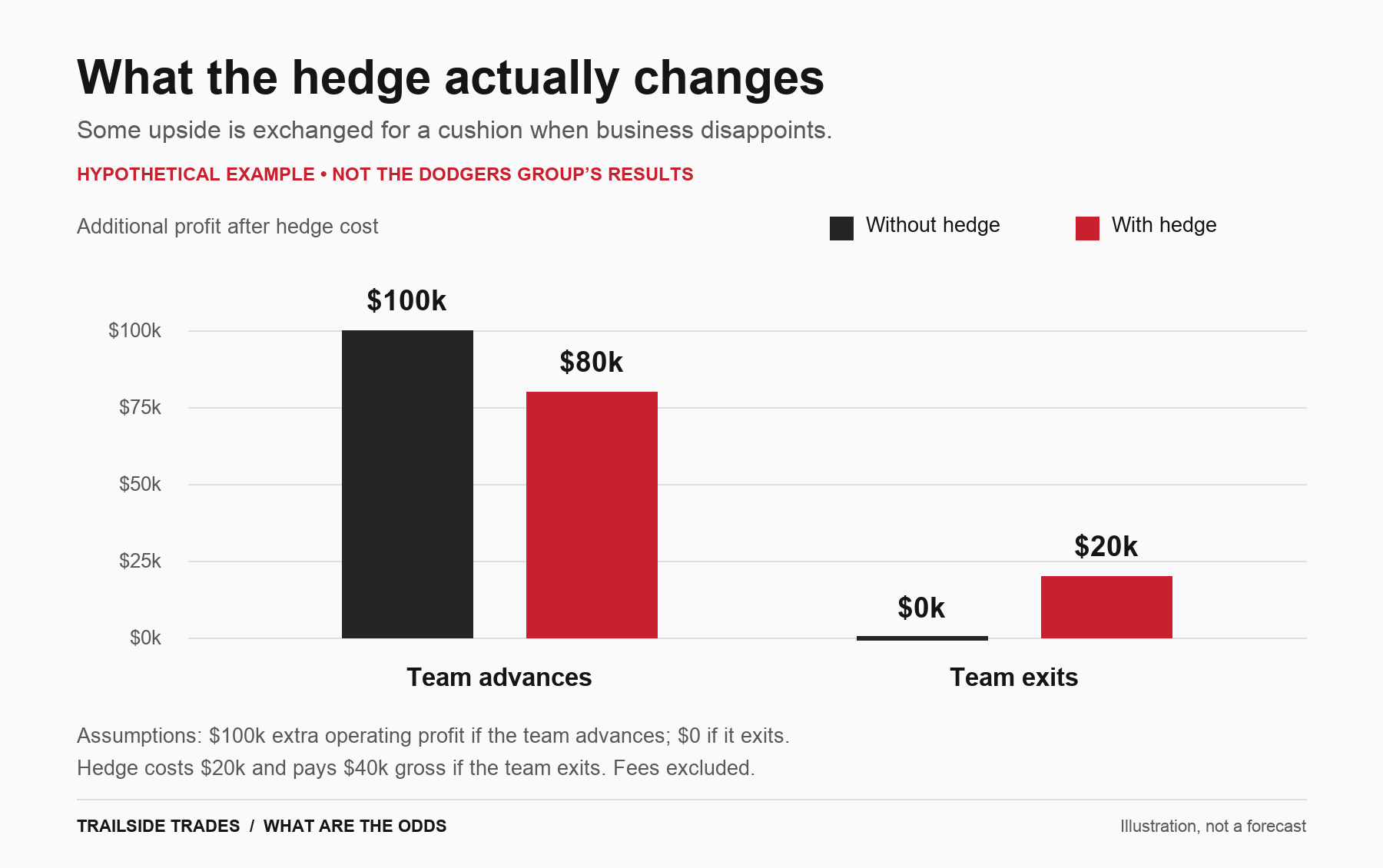
On a leaderboard, that looks terrible.
Across the business and the hedge, the result might be exactly what they wanted.
The owner doesn’t need to be the world’s best baseball forecaster for that arrangement to have value. They need to understand their exposure, what the contract actually covers, and whether the price makes sense.
That gives us a broader definition of a successful prediction-market user.
Even more important in my eyes is that prediction markets trade as a market, with a order book of takers and makers.
Unlike a black-and-white event of seeing the hedge to completion or not hedging at all, a business could close their hedge early to see a stronger upside in the combined result.
Maybe the local team is unlikely to win the championship, but going to the finals or even a conference final will provide you with value and save on part of the hedged position.
We’ve done versions of this before.
Financial markets have been transferring risk for a long time. CME’s weather derivatives, for example, allow businesses to hedge exposure to temperature measures.
Prediction markets didn’t invent the idea of getting paid when something goes wrong elsewhere in your finances.
What is interesting is how accessible and specific some of these exposures could become, and how much work remains between a contract existing and somebody being able to use it well.
A business owner thinks:
“If this happens, my business takes a hit.”
Polymarket & Kalshi offers:
“This contract pays if this precisely defined condition is met.”
Connecting those two statements is an actual problem worth solving.
A contract on a city’s temperature might only partly match what happens to a particular restaurant’s sales. A team advancing might create different amounts of business depending on the schedule. A hedge based on lost revenue could be too large if it ignores the costs the business avoids.
University of Maryland professor Daniel McCarthy makes this distinction in his discussion of the Dodgers example: businesses need to estimate the profit at risk and assess how closely the available contract matches their exposure.
That sounds like homework.
The businesses around the markets are getting interesting
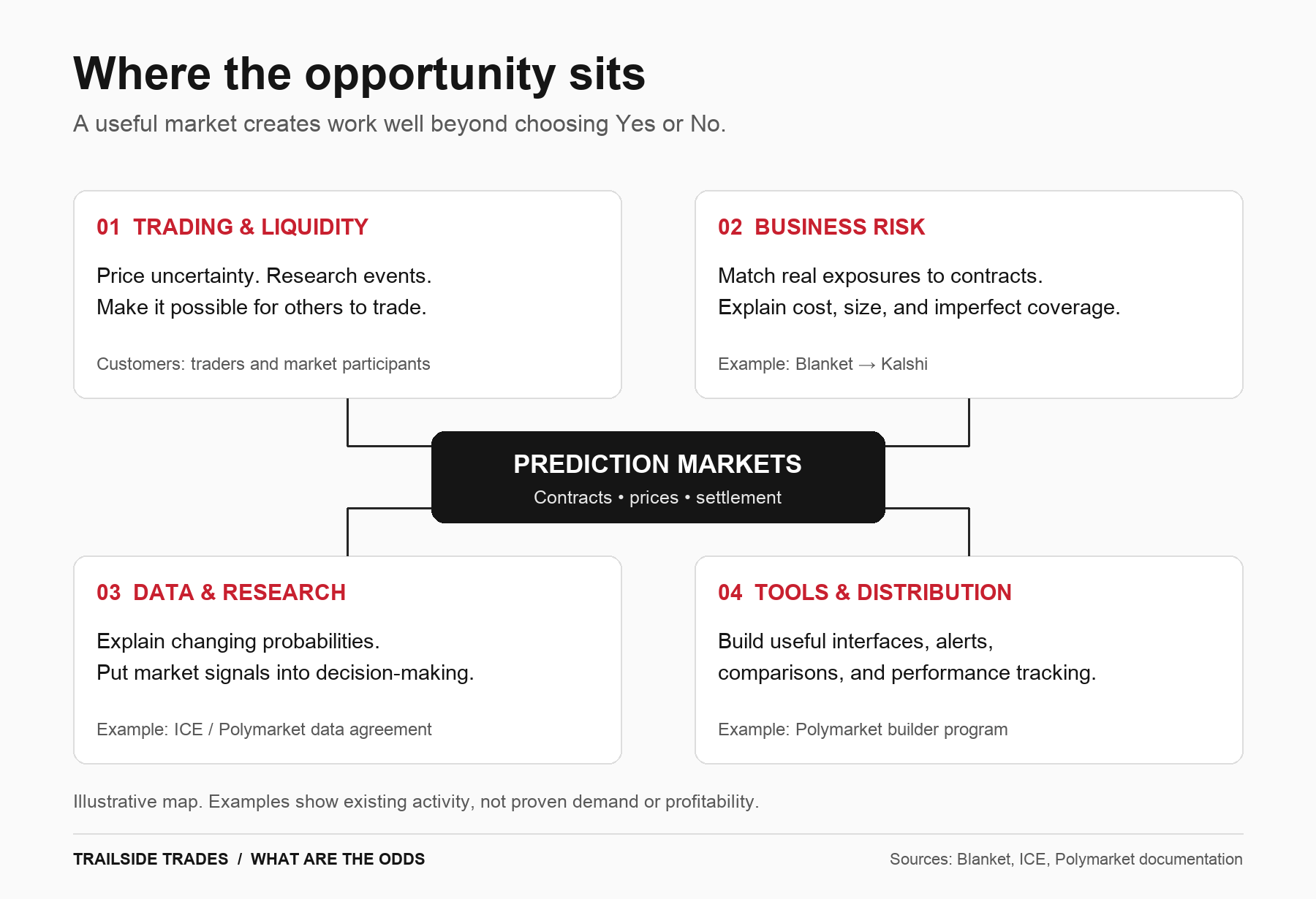
Once people can trade on events, a whole set of other needs appears. They need to find relevant markets, understand the rules, compare prices, interpret changes, and work out whether a position does anything useful for them.
Some of this is already taking shape.
Turning a business problem into a usable hedge
Blanket is an independent tool (I have no affiliation with the product) that asks users to describe a business risk, then looks for Kalshi markets that could partially offset it. Its site also allows for the answer that no suitable market exists. Trades still happen on Kalshi.
The interesting part is the translation.
A restaurant owner probably doesn’t start the morning thinking about binary or non-binary contracts. They might start it worrying about a weather forecast and a weekend full of outdoor reservations.
A product could connect that concern to an available market, explain the cost, show the potential payout, and make the mismatch obvious.
The existence of the tool doesn’t prove customers will adopt it or that every suggested hedge will work well. It does show somebody building around a concrete problem.
That is a much more useful starting point than “we put AI on a dashboard.”
Making the information useful.
There is also value in the prices these markets produce.
In October 2025, ICE (spelling this out because I was confused for a second to -InterContinental Exchange), the owner of the New York Stock Exchange, announced an investment of up to $2 billion in Polymarket alongside an agreement to distribute its event data to institutional customers.
The data agreement is the key part.
Someone can use a market’s changing assessment of an event without placing a trade. It can inform research, scenario planning, or the questions they ask about an existing investment.
The useful product might explain why a probability moved, whether related markets agree, and how much confidence to place in the signal.
A number on a screen is a starting point. A thin market moving after a small trade deserves different treatment from a deep market repricing after important information.
There is room for people who can make that distinction understandable.
Building the experience around the exchange
Polymarket also has a builder program for developers creating applications that route orders through its markets.
That creates room for different interfaces serving different users.
A sports researcher, a business owner, and someone following economic releases probably don’t need the same homepage.
I can imagine useful products built around one category: relevant sources, historical probabilities, important dates, contract explanations, and a way to track decisions afterward.
The hard part is identifying something people repeatedly need.
Another screen full of percentages is easy to imagine. Something worth paying for takes more work.
Different people can want different things from the same trade
This also changes how I think about who is on the other side of a position.
A trader may believe an event is mispriced.
A business may want a payment if an event hurts its earnings.
A market maker may be willing to quote both sides and manage the resulting exposure.
Those participants can have different reasons for accepting a price.
The business might reasonably pay for protection even if it expects the hedge, considered alone, to cost money over time. The trader taking the other side accepts a risk and wants sufficient compensation.
That doesn’t make either participant an idiot.
It also doesn’t mean new hedging demand automatically creates easy trading profits. Competition, fees, execution, and changing probabilities still exist. Nobody switched those off because a bar owner joined.
But a market serving several genuine purposes has a more interesting foundation than one whose entire pitch depends on everyone believing they will outperform everyone else.
Which… as we discussed previously, is NOT the outcome that occurs (in any market, nevertheless, prediction markets).
So where would I look for opportunity?
I’d separate it into three areas. This is also just off the dome, so understand there are more areas to explore.
First, specialist research and trading.
If you understand a particular subject deeply, there may be opportunities to turn that knowledge into better probability estimates.
The important work is establishing whether the knowledge actually helps at the prices available. Following a sport closely or reading every economic release gives you material to work with. You still need a process for turning it into decisions and evaluating the results.
That is a worthwhile area to explore. I’d rather investigate one category properly than pretend familiarity with everything on the homepage.
The most important part of this? The more niche a topic (WITH A MARKET TO TRADE), the higher the likelihood you will have an edge over others and be +EV.
Second, helping people use the information.
A good research product could explain what changed, what the market appears to be pricing, and what evidence would challenge that view.
For a business, it might connect probabilities to planning decisions. For a trader, it might make an unfamiliar market understandable. For a reader, it might provide a useful check on a confident headline.
That takes judgement and an understanding of the underlying market (and prediction markets as a whole).
I understand them and enjoy them, but I am not a statistician (my other newsletters are called ‘Degen Diaries’ so that should tell you something about me being able to spit out the right answer for most prediction market outcomes.
Copying a percentage into a newsletter takes about four seconds.
The difference is what the reader understands afterward. Hopefully these articles help you all.
Third, solving the practical problems around participation.
Finding relevant contracts. Comparing equivalent markets. Understanding settlement rules. Tracking performance properly. Estimating business exposure. Showing what a hedge does across different outcomes.
These are all potential products or services.
They still need customers and sensible economics. “Prediction markets are growing” is not a business model on its own.
But there is a much wider set of opportunities here than picking the next winning contract.
What I want to see next
The Dodgers story is a useful example and not the only one.
The next evidence I’d look for is fairly practical.
Do businesses use these markets again and specifically put on similar trades year to year, season to season, quarter to quarter?
Can they get enough protection at a reasonable price?
Are the contracts clear enough that people understand what will pay and what won’t?
Those questions also point toward the work still available.
For a hedge to be useful at meaningful size, there needs to be enough liquidity.
For a data product to be useful, it needs context.
For a business owner to come back, the experience needs to solve a problem they actually have.
I’m (overtly) supportive of prediction markets because I think there is real value in making uncertainty something people can examine, price, and act on.
Legally of course - versus being in a blackhawk going dark into Venezuela and slamming a market with your life savings that your country is about to take military action against a foreign leader... among other sus ways to use prediction markets.
I want to see what gets built for the next person who realizes they already have a bet on the world, and would like a little more control over it.
Over the next few weeks I will be sharing some other examples of businesses across the US and world that have used prediction markets as a form of bespoke insurance to guard against outcomes that are outside (or within) their control.
WHAT ARE THE ODDS is a series within The Risk Curve where I write about prediction markets, weird data, new research, interesting hedges and whatever else in the space happens to tickle my brain.
Hit me with a reply in the comments if you trade prediction markets, and have ever used these markets to hedge in a bias.
Follow me on X: @TrailsideTrades
Subscribe on Youtube: TrailsideTrades I go live every thursday to talk crypto markets.
I am writing as part of The Trading Initiative team where we cover and trade US equity and crypto markets on a daily basis, if you want to learn more check it out here: https://thetradinginitiative.substack.com/about
Material, data, and information in this newsletter are for informational purposes only. This is not tax, legal, or investment advice, and does not constitute a suggestion, solicitation, or offer to buy or sell securities. TTI believes this information is reliable but does not warrant its completeness or accuracy.
Is that really true about the LA ice cream shop example?!